Rabby Wallet Extension: Why Multi-Chain Transaction Simulation Matters in DeFi
You are about to swap tokens on a decentralized exchange when your browser wallet shows a request that looks routine: connect, approve, sign. The dollar value appears reasonable, so it is tempting to click through. Yet the most important question is not always “How much am I sending?” It is often “What will this transaction cause my account to do?” That distinction is where a multi-chain wallet such as Rabby becomes interesting. Its value is not simply that it stores keys or connects to many networks. The more useful idea is that a wallet can act as a reasoning layer between a DeFi application and the user’s signature.
For someone in the US moving between Ethereum, layer-2 networks, and other EVM-compatible chains, that layer can reduce a familiar source of confusion: the same browser may be connected to several networks, while each transaction has different fees, contracts, liquidity conditions, and risks. But transaction simulation is not a crystal ball, and a wallet warning is not a substitute for judgment. The practical advantage comes from understanding what the wallet can inspect, what it can infer, and where its view ends.
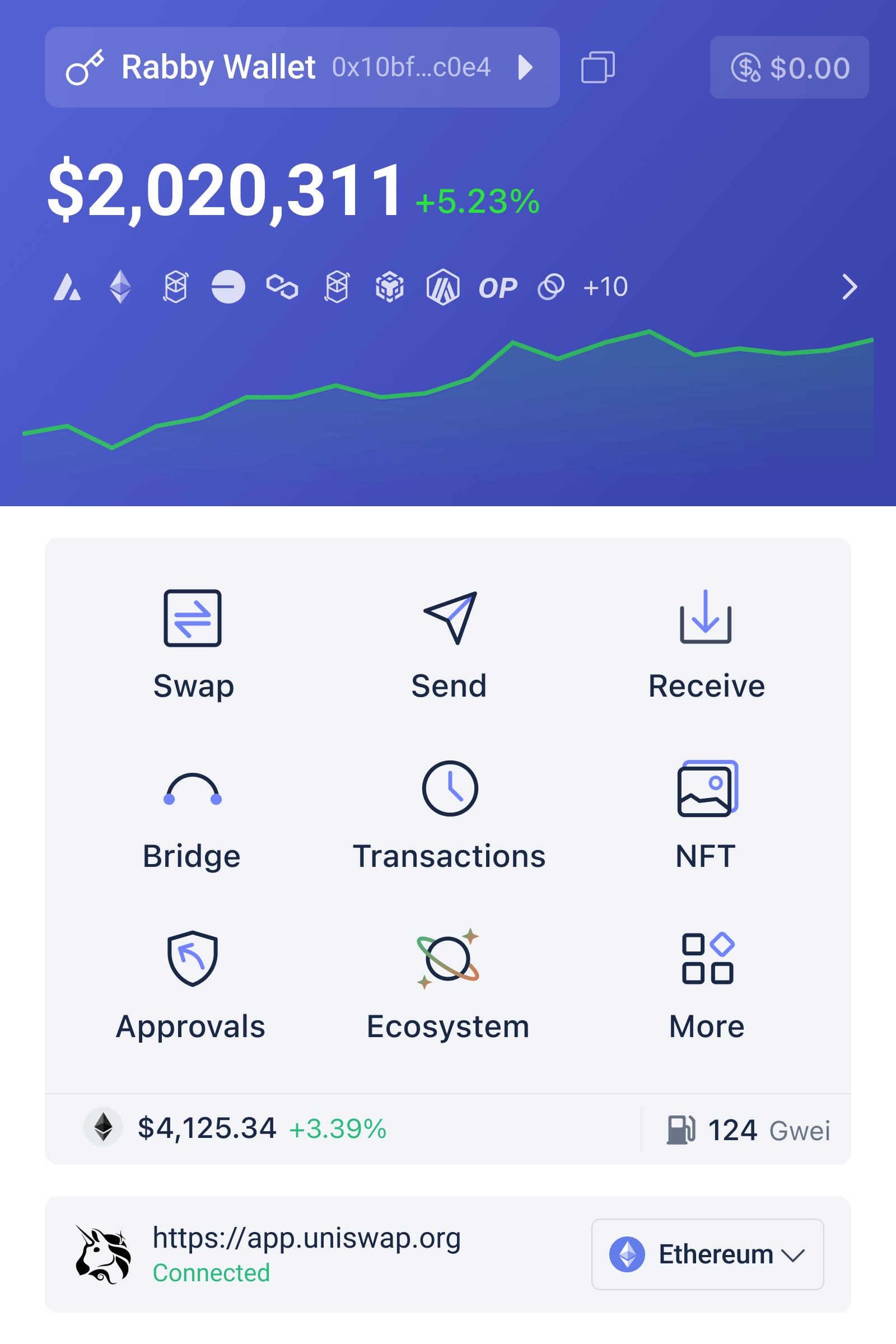
Myth: a multi-chain wallet is just one wallet with more networks
The simple description is technically convenient but conceptually incomplete. A multi-chain wallet extension manages access to accounts that interact with multiple blockchain networks, often within the same browser workflow. In the Ethereum ecosystem, many of those networks use compatible transaction formats and smart-contract standards, which makes a unified interface possible. The interface can present balances, token approvals, network selection, and contract interactions in one place rather than forcing a user to treat every chain as a completely separate product.
The benefit is not only convenience. A single DeFi strategy may involve several environments: a stablecoin on one chain, a lending market on another, and a bridge or exchange used to move between them. The wallet helps assemble those actions into a more legible sequence. That is useful because operational mistakes are often more mundane than sophisticated. A user may be on the wrong network, interact with a similarly named token, misunderstand a contract approval, or underestimate the native token required for gas.
Still, “multi-chain” does not mean “chain-agnostic.” Each network has its own transaction history, finality assumptions, fee market, contract ecosystem, and operational risks. A token symbol can appear identical across chains without representing the same asset or having the same liquidity. A familiar application name can also point to different deployments. Before installing any extension, users should obtain it through a trusted, verified distribution path and check the publisher, permissions, and domain carefully. Those steps matter because a wallet extension is a security-sensitive interface: if the installation source is fraudulent, a polished design offers little protection.
Readers who want to review the installation process can use this rabby wallet resource as a starting point, then verify that the download and setup flow matches the wallet’s current official information. During setup, the seed phrase should never be entered into a website, shared with support, or stored in an ordinary cloud document. A browser wallet can make signing clearer, but it cannot recover a secret phrase that has been exposed.
Myth: transaction simulation tells you whether a transaction is safe
Transaction simulation is better understood as a preview of execution than as a safety certificate. Before a transaction is broadcast, a wallet may attempt to model what the relevant smart contracts would do if the call were executed under current conditions. The result can reveal expected token transfers, approvals, contract interactions, balance changes, or a likely failure. This is a meaningful improvement over signing opaque data, particularly when a DeFi application constructs a complicated call behind a simple button labeled “Confirm.”
The mechanism is important. A transaction normally contains information such as the destination contract, function call, parameters, gas settings, and the account that will sign it. A simulation runs an approximation of that call against blockchain state or an associated execution environment. If the call succeeds in the preview, the wallet can translate some of the low-level activity into a human-readable summary. If it fails, the user may be able to stop before paying a fee for a transaction that was unlikely to work.
That preview creates a sharper mental model: the wallet is not deciding whether the user’s financial objective is sensible; it is estimating how the requested instructions will affect the account. A simulation might show that a swap sends one asset and receives another. It may also expose that the interaction grants a token allowance to a contract, or that an operation touches an unfamiliar address. These details can turn a vague signature request into a concrete question: do I recognize every meaningful effect?
But execution and simulation are not identical. Blockchain state can change between the preview and the mined transaction. A swap’s price, available liquidity, nonce, gas conditions, or lending-market position may move. Some applications depend on block timing, oracle updates, signatures from other parties, or conditions that are difficult to reproduce exactly. A malicious contract may also behave differently under particular conditions. In addition, a wallet’s interpretation depends on the data it can access and decode; an unfamiliar or newly deployed contract may not be presented with the same clarity as a widely used protocol.
The overlooked risk: approvals can outlive the transaction
One of the most important DeFi distinctions is the difference between a one-time transfer and an allowance. When a user approves a token for a contract, the contract may gain permission to move that token from the user’s account later, subject to the allowance and the token’s rules. The approval can therefore be more consequential than the immediate swap or deposit. A user may finish the intended action while leaving a broad permission in place.
This is where simulation and wallet warnings are especially useful, but also where user interpretation matters. A warning about an approval does not automatically mean the protocol is malicious; many legitimate applications need allowances to perform routine actions. Conversely, the absence of a dramatic warning does not establish that an allowance is prudent. The decision depends on the contract, the amount, the duration of the permission, and the user’s willingness to monitor or revoke it later.
A practical habit is to read the transaction in layers. First, identify the network and the account that will sign. Second, identify the contract and the primary action. Third, inspect assets leaving the wallet and assets expected in return. Fourth, look specifically for approvals, permit-style signatures, or permissions that extend beyond the immediate action. Finally, ask whether the transaction still makes sense if the displayed exchange rate, gas cost, or execution timing changes slightly.
Installation is the beginning of the security process
Downloading a browser extension is often treated as a one-minute task, but the security process starts before installation. Fake extensions and imitation websites exploit the fact that users search by brand name and click quickly. A careful workflow includes checking the official source, reviewing the extension’s requested permissions, confirming the browser is using the intended profile, and refusing unsolicited “support” instructions that ask for a seed phrase or private key.
After installation, a hardware wallet can provide an additional boundary for users managing significant funds, although it does not make every transaction safe. The hardware device protects key use, while the browser wallet helps present the request. Those are different functions. If the user approves a malicious contract interaction on the hardware device, the physical confirmation may still authorize the harmful action. Security improves when the signing device, wallet interface, application domain, and transaction details are all checked together.
Separate accounts can also reduce the blast radius of mistakes. One account might hold long-term assets, another might be used for routine DeFi activity, and a third might be reserved for testing unfamiliar applications with limited funds. This is not a guarantee against loss, but it recognizes an important operational truth: convenience and exposure often increase together. A wallet that makes it easy to explore many chains can also make it easy to carry a mistake from one familiar workflow into a new environment.
What transaction simulation cannot see
The boundary conditions deserve as much attention as the feature itself. Simulation generally describes a likely state transition; it does not independently verify the team behind a protocol, the quality of its code, the legitimacy of an asset, or the economic sustainability of a yield strategy. It may show that a transaction executes correctly while the received token is difficult to sell, the protocol is economically fragile, or the application’s front end is misleading users.
There is also a difference between technical success and financial success. A bridge can complete while exposing the user to risks associated with custody, liquidity, or the destination chain. A swap can execute while producing poor value because of slippage or thin liquidity. A lending transaction can be valid while leaving the position vulnerable to liquidation if collateral prices move. Simulation can clarify mechanics, but it cannot remove market risk, governance risk, oracle risk, or legal and tax considerations relevant to a US user.
The absence of recent project-specific news in the current update window is itself a reason to keep the analysis focused on durable mechanics rather than invented announcements or implied product changes. Users should confirm current extension behavior, supported networks, and security guidance through official sources before relying on any feature. If future wallet updates improve decoding, simulation coverage, or permission management, the meaningful signal will be whether those improvements reduce ambiguity without encouraging users to stop checking the underlying transaction.
A reusable decision framework for DeFi transactions
The most useful way to evaluate a wallet is not to ask whether it makes DeFi risk disappear. Ask whether it improves the quality of the user’s decision at the moment a signature is requested. A strong workflow combines four checks: identity, intent, impact, and reversibility.
- Identity: Is the network, application, contract, and account what you intended to use?
- Intent: Does the transaction perform the action you believe you selected, or is it requesting a broader permission?
- Impact: Which assets, allowances, and permissions change if the transaction succeeds?
- Reversibility: If something goes wrong, can the action be undone, or would recovery depend on selling assets, revoking access, or accepting a permanent loss?
This framework adds an overlooked dimension: reversibility. Users often focus on the amount being sent, but a modest transaction that grants a large allowance may be less reversible than a larger one-time transfer. Likewise, a bridge transaction can change where an asset exists and which systems control its movement. Simulation helps with impact; the user must supply the judgment about identity, intent, and reversibility.
Looking ahead, wallets may become more valuable as interpreters of machine-readable permissions rather than merely as key managers. That outcome is plausible if protocols expose clearer transaction data and wallets improve how they explain dependencies across chains. The limiting factor will remain information quality: no interface can reliably summarize a contract behavior that is opaque, state-dependent, or deliberately deceptive. The best future is therefore not “sign without thinking,” but fewer occasions where users are forced to sign without understanding.
Frequently Asked Questions
Is Rabby suitable for every DeFi user?
It can be useful for users who interact with several compatible networks and want clearer transaction context, but suitability depends on the user’s security habits and the applications they use. Beginners should start with small amounts, verify networks and domains, and learn how approvals work before managing significant funds.
Does a successful transaction simulation guarantee that I will not lose money?
No. Simulation can indicate how a transaction is likely to execute and may reveal transfers or permissions, but it cannot guarantee market value, protocol solvency, token liquidity, bridge safety, or future contract behavior. Treat it as an evidence layer, not a guarantee.
What should I check before installing a wallet browser extension?
Use a trusted official distribution path, verify the publisher and browser listing, inspect requested permissions, and protect the seed phrase offline. Never enter the seed phrase into a website or give it to someone claiming to provide technical support.
A multi-chain wallet is most valuable when it slows down the right moment. Before a signature, the question is not merely whether the button works. It is whether the requested action matches the user’s intention, whether its permissions are proportionate, and whether the consequences can be contained. Transaction simulation makes that examination easier. Human attention still makes it meaningful.